The Joy of the Family Table
A recent Wall Street Journal article described dinner as the "number one pain point in modern family life." Many of us could recognize the picture it paints: crowded calendars, tired parents, and a question that arrives every afternoon with no answer ready. The article reports that about 80% of Americans still do not know at 4 p.m. what they will have for dinner, and that one in five meals is eaten in the car.
Still, the same numbers could tell a more hopeful story. Americans now spend an average of 43 minutes a day on food preparation and cleanup, and the time men spend in the kitchen has roughly doubled since 2003. More hands and more hours are going into feeding our families, which suggests that the desire for a home-cooked meal and a shared table has not gone away.
What may have slipped from view is the very reason we do it.
Consider why a family exists in the first place. We work, plan, earn, and serve so that those we love are cared for. Dinner is where that effort comes home. It is the one daily moment when the people we work for are seated in front of us, and when the other hours of the day find their meaning.
When the table is treated as one more task, it can feel heavy. However, when it is seen as the reason for the rest of the effort, it could become the most joyful part of the day.
That joy does not depend on a perfect schedule. Some families may find that a late practice, a long shift, or a school function makes 6 p.m. impossible. In those seasons, a family could try sitting down with the one who arrives last, even for fifteen minutes, so that no one eats alone. A shared breakfast can also serve just as well as an evening feast. What matters is that someone is across the table, offering attention and welcome.
This week, a family might simply ask: what would make tonight's meal something we look forward to? It could be a candle, a cloth napkin, a favorite song in the background, or a place saved for the one still on the road. Even on the busiest evenings, a few moments of thanks before the first bite could turn an ordinary meal into something worth cherishing.
Why do we set the table?
A set table is inviting. It creates a sense of order before the meal begins, and it signals that this gathering is an event worth honoring. It also makes sure everyone has what they need, so no one has to leave the table to find a missing fork or napkin.
Setting the table can also be a small way to invite every member of the household into the meal. One practical idea is to tape a printed table-setting template inside a kitchen cabinet door, or anywhere within easy view of whoever is setting the table.
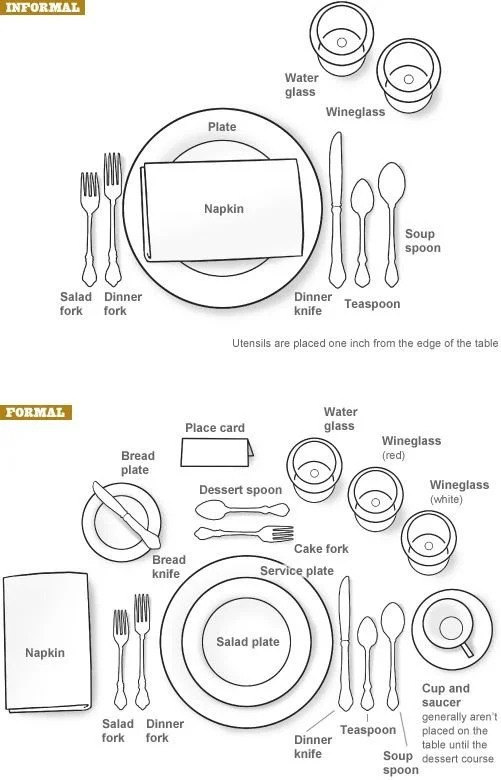
With a simple diagram showing where the plate, fork, knife, spoon, and glass belong, the question “Where does the fork go?” can be answered before it is asked.
Your table may not include every element shown, and that is perfectly fine. The diagram is a guide, meant to foster independence and confidence in children, guests, and anyone else lending a hand.
The same guide can serve any meal, from a hot dogs and macaroni and cheese dinner on a busy weeknight to the Thanksgiving table. Either way, a little care at the table can make the evening feel more special, and it gives everyone a part in it.